UAVs · LoRa · Edge Computing
52,000
Deaths in Türkiye earthquakes (Feb 2023), communication collapse a key factor
5
Core research objectives spanning network lifetime, security, heterogeneous networks & prototyping
6
UAVs in simulated star topology stress-tested at 4.5× normal traffic load
85
Data collection points (340 high-res images) from DJI Mini 4K drone at 4 altitudes
4
Institutions involved from Turkey, Pakistan, UK, cross-continental consortium
GDPR
Compliant architecture with data minimisation, encryption, logging & auditing built in
Why This Matters
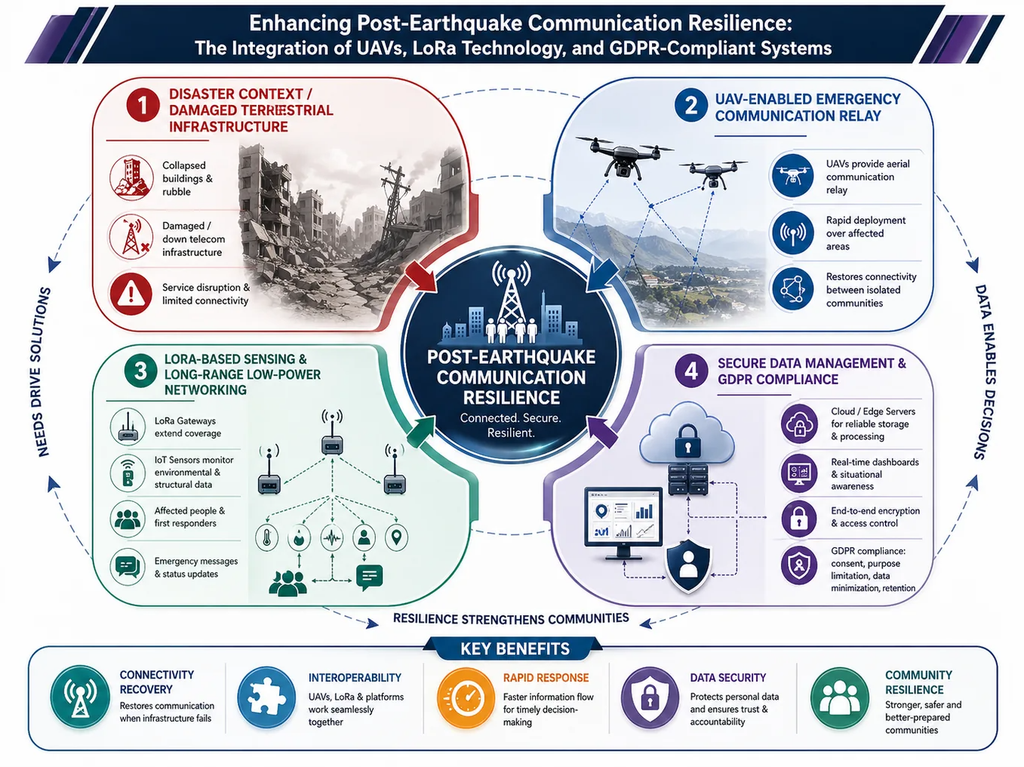
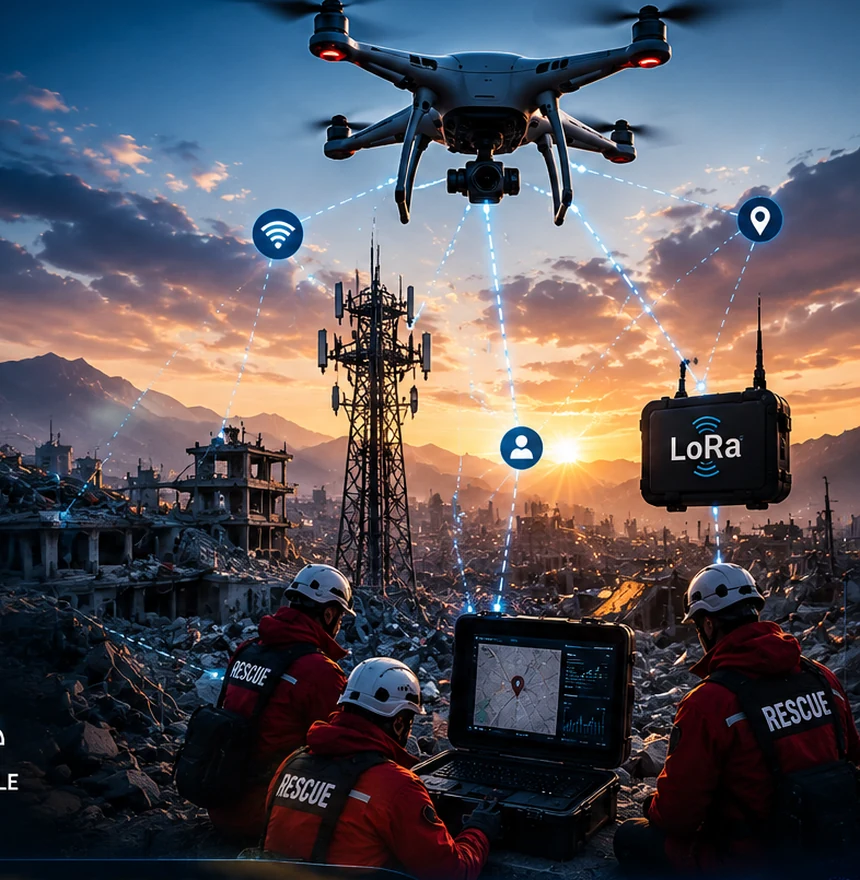
Earthquakes cause instant collapse of cellular towers, fibre-optic links, and power infrastructure, precisely when communication is most critical. Network overload blocks rescue coordination; isolated communities receive delayed aid; first responders operate blind. Traditional networks fail the moment disaster strikes. This project builds the technological alternative: autonomous, airborne, energy-efficient, and privacy-preserving communication that deploys in minutes, not hours.
Earthquakes that drove this research project:
1,000x
Projected increase in mobile data traffic by 2020
100Kx
Of women in labour force work in agriculture
4.5x
Traffic stress tested above normal in OMNET++ simulation
Zero
Data loss target in Stop-and-Wait ARQ protocol design
1 Mbps
Wireless data rate configured with 1e−6 BER in simulation
System Architecture
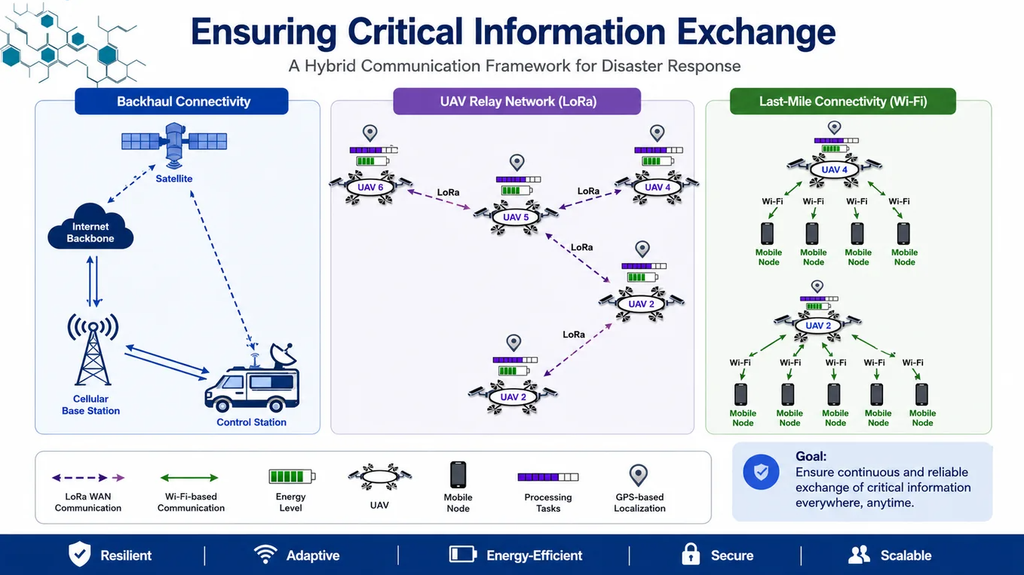
UAV — LoRa — Edge — Ground Station Communication Chain
Research Objectives
1
ENSURE CRITICAL INFORMATION EXCHANGE
UAV-based LoRa mesh network facilitating victim-to-backbone communication. Edge-integrated UAV relay network supporting on-board machine learning and deep learning inference. Customised mobile application for direct communication with victims during disaster events.
2
EXTEND NETWORK LIFETIME
Adaptive power management to conserve energy across UAVs and sensor nodes. LoRa node clustering and load balancing for equal energy distribution. Sleep-wake protocols for long-term monitoring of collapsed urban zones. UAV duty cycling based on dynamic communication demand.
3
UTILISE HETEROGENEOUS NETWORKS
Context-aware network switching across cellular, satellite, wired infrastructure, and LoRa. Handover mechanisms ensuring uninterrupted data flow between network types. Wide-area coverage through UAV integration with satellite links to close post-disaster communication gaps.
4
GDPR-COMPLIANT SECURE COMMUNICATION
Data minimisation and anonymisation to ensure citizen privacy during UAV data collection. Lightweight XOR-based encryption for protecting sensitive IDs and location data in UAV–LoRa networks. Fully GDPR-compliant data logging and auditing architecture enabling traceability and forensic accountability.
5
FUNCTIONAL PROTOTYPE FOR VALIDATION
Real-world deployment of UAV communication pods in earthquake drills. Multi-UAV simulation framework stress-testing disaster network resilience. Modular UAV platform enabling easy testing of security and routing protocols. University-based testbeds simulating pre- and post-disaster communication. Scenario-based validation for first responders, civilians, and agencies.
Technology Stack
UAV / FANET
Flying Ad-hoc Networks using multiple UAVs forming temporary mesh relays. Centralized star topology (up to 6 UAVs) to a ground station hub in simulation.
LoRa / LoRaWAN
Long-range, low-power wireless communication ideal for disaster zones. Clustered node architecture with load balancing for maximum operational lifetime.
Edge Computing
On-board ML/DL inference on UAV platforms. Fast, decentralised processing without dependence on central servers, critical when backbone connectivity is severed.
GDPR Security Layer
XOR-based lightweight encryption for all payloads. Data minimisation, anonymisation, and a complete audit logging architecture compliant with EU data protection law.
OMNET++ Simulation
FANET simulation framework modelling UAV mobility, LoRa application layer (LoRaUAVApp), network topology (FANET_Network.ned) and QoS priority queuing.
DJI Mini 4K UAV
Used for pavement crack detection data collection at METU-NCC. Images captured at 3m, 5m, 7m, and 9m altitudes with GPS coordinates for real-time mapping.
Impact at a Glance
Goal: rapid, reliable post-earthquake damage assessment of road infrastructure via UAV imagery. Built a custom dataset (CoGRCDD) to overcome labelling inconsistencies in existing datasets (RDD2022, Crack500). Optimised for edge deployment on UAVs.
- 85 data points — 340 high-resolution images retained
- 4 capture altitudes: 3m, 5m, 7m, 9m above METU-NCC campus
- Every datapoint includes GPS coordinates for real-time mapping
- Addresses visual interference: oil spills, puddles, shadows
Secure and priority-based UAV network simulation framework developed. Key simulation files include FANET_Network.ned, UAVMobility.cc, and LoRaUAVApp.cc.
- QoS: high-priority queue at Ground Station for critical data
- Reliability: Stop-and-Wait ARQ protocol — zero data loss target
- Security: XOR-based lightweight encryption on all payloads
- Stress test: 34,000 messages vs normal 7,500 (4.5× load)
- CRITICAL missions bypass standard traffic under congestion
Simulation Specifications
Network Topology
Centralized star, up to 6 UAVs
Wireless data rate
1 Mbps
Bit Error Rate (BER)
1×10⁻⁶
Priority levels
Low → Routine → High → Critical
Normal traffic volume
7,500 messages
Stress test volume
34,000 messages (4.5×)
Reliability protocol
Stop-and-Wait ARQ + ACK
Encryption
XOR-based lightweight
Simulator
OMNET++
Data compliance
GDPR-compliant logging/auditing
Context Data
Research Activities
Training Workshops
Focused on IoT, AI, and UAV interaction, building capacity across consortium institutions in Turkey and Pakistan.
Collaborative R&D
Establishing cross-national research groups between BUITEMS, METU-NCC, Middlesex and Glasgow for sustained joint research.
Industry-Academia Events
Networking events bringing together academic researchers and industry practitioners around disaster communication technology.
Public Engagement
Seminars, public lectures, and media outreach disseminating findings to policymakers, emergency services, and civil society.
Prototype Deployment
Developing and deploying functional UAV communication pod prototypes in real earthquake drill scenarios for field validation.
Long-term Monitoring
Feedback mechanisms for sustained monitoring of deployed systems, enabling iterative improvement and evidence generation.


Consortium Partners
Institutional Partners & Collaborators